Accurate patient identification is foundational to safe care. A simple wristband—when printed, applied, and scanned correctly—can prevent wrong-patient medication, mislabelled specimens, wrong-site procedures, and countless cascading errors. This article explains the evidence, technology choices (barcode vs RFID), the technical importance of clear 300-dpi printing, infection-control concerns, material selection, and how the Zebra ZD510-HC improves workflow in clinical settings.
Global scale: how big is the patient identification problem?
Patient misidentification is not a niche issue. The World Health Organization and national patient-safety bodies frame identification errors as a root cause for many adverse events, including sentinel events like wrong-site surgery. For example, an analysis of sentinel events noted patient identification problems among a significant share of reported incidents. WHO and national reports emphasize that correct identification must be a priority for every hospital. World Health Organization
Systematic reviews and meta-analyses show large potential gains from using barcoded medical-grade alcohol-resistant wristbands: a pooled analysis found that barcode wristband medication-scanning reduced medication-error rates substantially—on the order of ~50–60% in study settings—by ensuring the “right patient, right medication” check is reliably enforced at the bedside. These reductions translate directly into improved clinical outcomes and lower avoidable cost. PMC+1
Role of wristbands in reducing mistakes — why they work
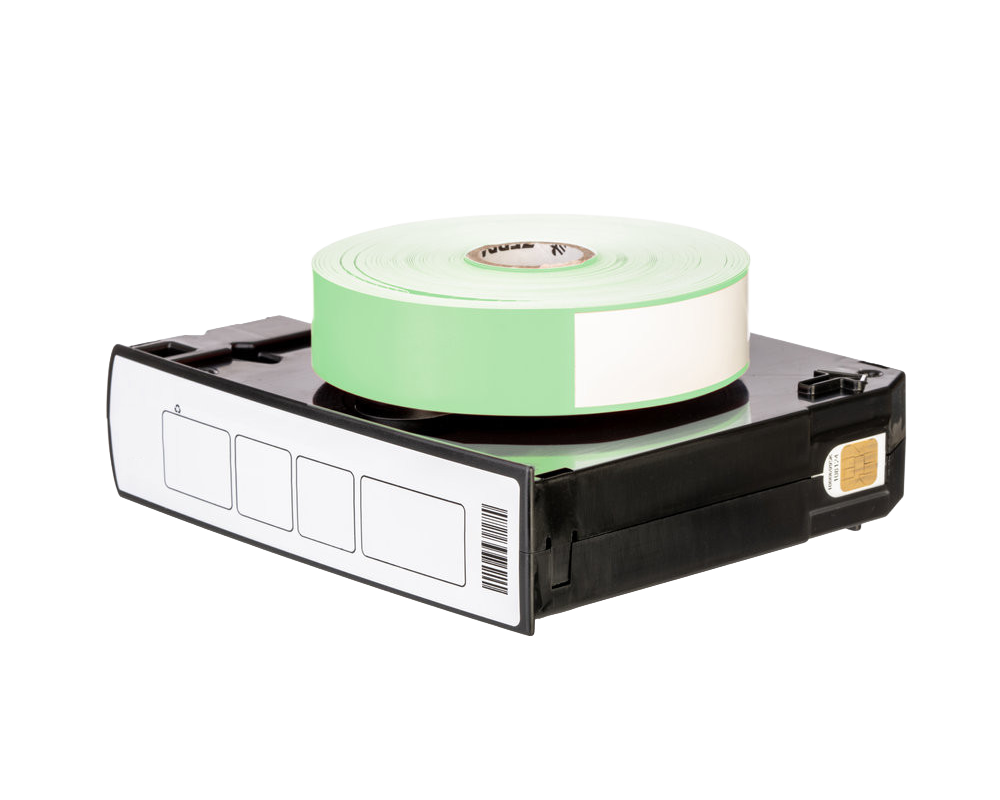
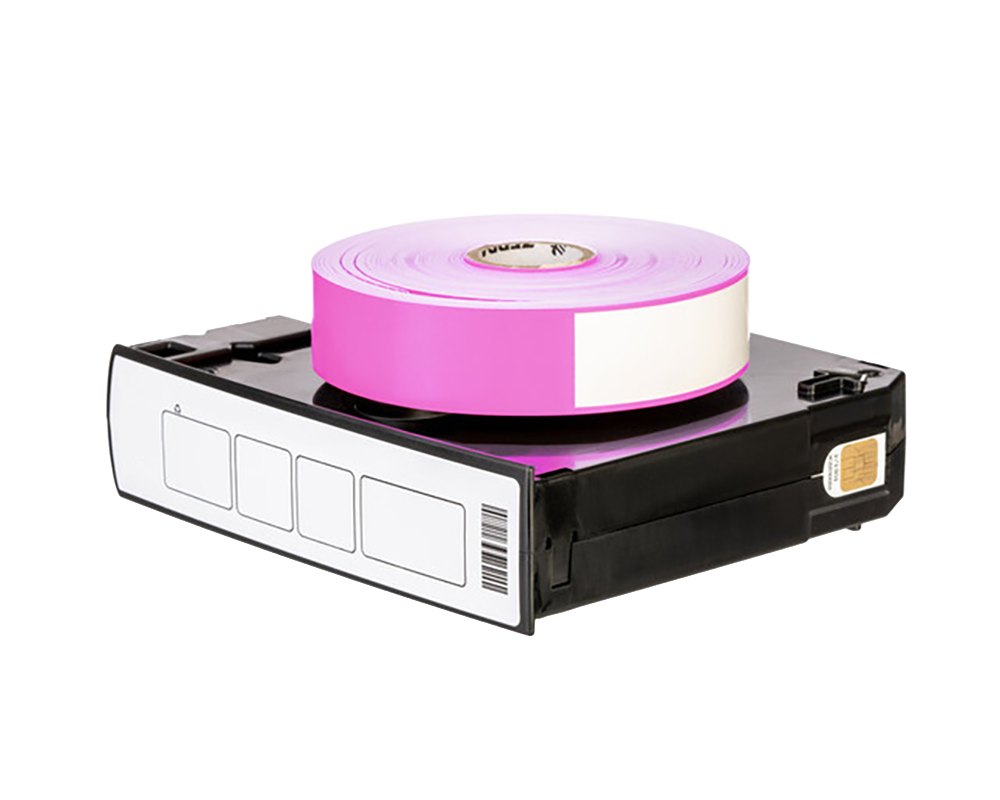
Wristbands act as the single, portable truth for a patient’s identity across departments. When an electronic health record (EHR) or medication administration record (eMAR) requires a barcode scan of the patient Zebra 10015355K wristband before a medication, blood draw, or imaging study, that step creates an enforced verification checkpoint. Compared with manual name-matching, scanning reduces human error, prevents transcription mistakes, and links every action to the correct charted identity.
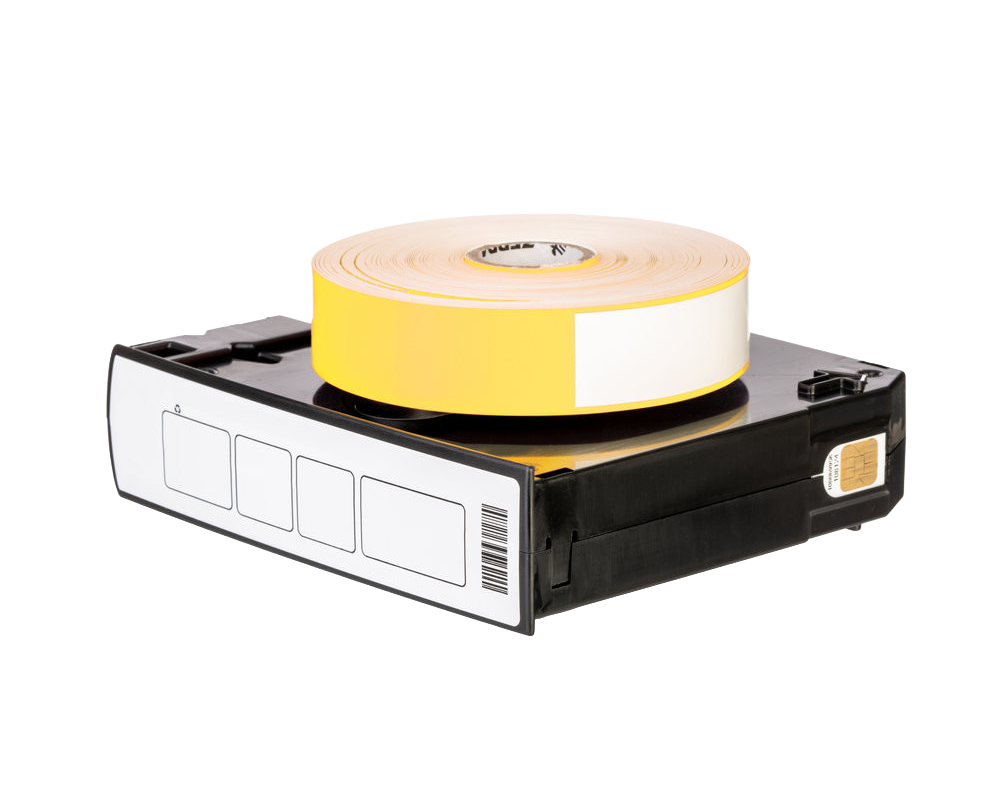
Practical benefits hospitals report include fewer specimen mislabels, reduced duplicate laboratory work, fewer medication administration errors, faster triage in ED settings, and measurable time savings for nursing staff—especially when Zebra 10015357K wristband scanning is embedded in routine workflows. Barcoding+1
Barcode vs RFID ID systems — advantages and tradeoffs
Barcodes (1D/2D)
- Pros: inexpensive, mature technology; scanners are cheap and widely available; integration with EHRs is straightforward. Barcodes require only line-of-sight and give very reliable reads when printed clearly.
- Cons: must be individually aligned and scanned; can fail if printing is poor or wristband surface is damaged.
RFID
- Pros: no line-of-sight required; can read multiple tags at once; enables real-time location and passive tracking use cases. RFID can be powerful where automatic detection of patient presence or simultaneous scans are useful.
- Cons: higher cost (tags + readers), more complex infrastructure, potential interference in hospital environments, and data-privacy/IT/security considerations.
In short: for most identification and medication-scan workflows, barcodes on wristbands deliver the best cost-benefit today. RFID adds value in logistics/asset tracking and certain high-throughput scenarios, but it is not yet a universal replacement for barcode wristbands in clinical bedside verification. Hospitals commonly use both technologies where each fits best. PMC+1
Why print quality (300 dpi) matters for patient ID wristbands
Print resolution directly affects barcode contrast, edge definition, and scanner read rates. Medical barcode printers that support 300 dpi (dots per inch) produce much sharper barcodes and small-font text than lower-resolution printers—this matters for small wristband formats where barcode density is high.
Clear 300-dpi printing reduces:
- scan failures (fewer rescans and delays)
- reprints (less waste and nurse time lost)
- misreads (fewer wrong matches)
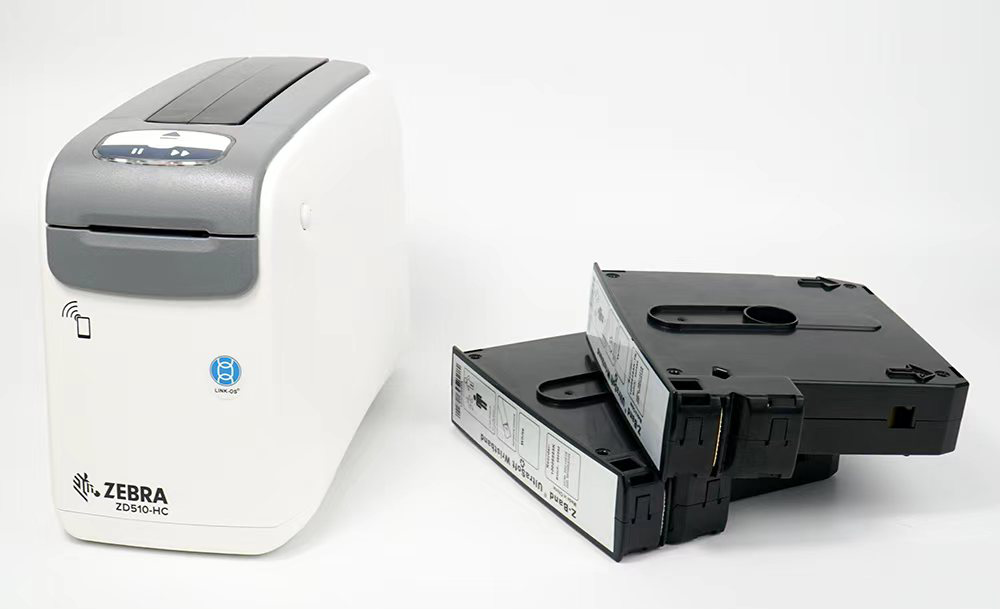
The Zebra ZD510-HC and similar healthcare printers explicitly offer 300-dpi resolution to ensure barcode precision on direct-thermal wristband 10015358K materials, which is a key technical enabler for reliable bedside scanning. Zebra Technologies+1
Hygiene & infection control: wristbands in a disinfected environment
Hospitals clean equipment frequently with alcohols and disinfectants. Wristband materials and printer casings should tolerate routine cleaning without degrading. Best practices:
- Use disinfectant-ready printer housings (materials that won’t crack or embrittle with repeated cleaning).
- Choose wristband materials and topcoatings that resist alcohol and sanitizer exposure so printed barcodes do not smear or fade.
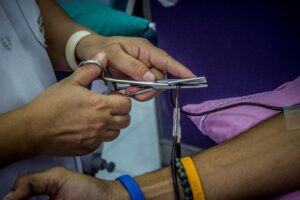
- Prefer single-use wristbands for infection control and replace bands after contamination or extended stays.
Zebra and leading medical-grade wristband manufacturers explicitly test both wristband coatings and printer housings for disinfectant resistance so the printing system and consumable survive real clinical use. Zebra Technologies+1
Choosing the right wristband material
Not all wristbands are equal. Material choice affects comfort, durability, and scan reliability:
- Polypropylene (soft) — common for patient wristbands: comfortable, printable with direct thermal, and widely used for neonatal/pediatric options.
- Vinyl — durable and comfortable, good for longer stays.
- Polyester / Tyvek — for specialty use where tear resistance or chemical resistance is prioritized.
- Adhesives — must be hypoallergenic, secure through bathing, and non-irritating to fragile skin (infants, geriatrics).
Procurement should insist on lab tests: barcode read-rate after alcohol exposure, adhesive hold times, tensile and tear resistance, and biocompatibility for skin contact. Reputable suppliers provide these test results and sample rolls for clinical trialing. Zebra Technologies+1
How the ZD510-HC improves workflow in hospitals
The Zebra ZD510-HC was built for healthcare workflows: it combines a healthcare-grade, disinfectant-ready housing with a cartridge system and 300-dpi print quality that together reduce human error and speed operations.
Key workflow benefits:
- Cartridge system: quick, error-proof loading—reduces misfeeds and staff training time.
- Automatic calibration: ensures the printer uses the correct parameters for each wristband type—no manual adjustments needed.
- High-quality 300-dpi printing: improves scan success rates and reduces repeat prints.
- Connectivity & integration: supports Ethernet, USB, Bluetooth/Wi-Fi options and works with EHR systems so printing can be triggered directly from patient charts.
- Disinfectant-ready design: allows frequent cleaning of the printer surface without performance loss.
Together, these features reduce bedside friction: nurses spend less time fixing or reprinting bands and more time on patient care—exactly where gains in safety and efficiency show up. Zebra Technologies+1
Practical recommendations (short list)
- Use barcode wristbands as the baseline identification technology for medication and specimen verification.
- Require 300-dpi printing for wristband printers to maximize read rates.
- Pilot compatible, medical-grade wristband materials with lab tests for alcohol resistance and adhesion.
- Train staff to scan at each critical point (medication, specimen, procedure) and to re-band when a wristband is soiled or damaged.
- Consider RFID only where automatic location tracking or simultaneous multi-tag reads add clear operational value. PMC+1
Conclusion
Patient ID wristbands—when paired with high-quality printing (300 dpi), medical-grade hospital wristband materials, and sound workflows—are a proven, cost-effective cornerstone of patient safety programs. Whether a hospital uses barcode wristbands, RFID, or a hybrid approach, the priority remains the same: reliable identification at the point of care. Choosing the right printer (like the ZD510-HC), durable consumables, and testing them under real clinical conditions will drive measurable reductions in errors and improve outcomes across the care continuum. World Health Organization+2PMC+2